

Summary:
Ever wondered why ants don’t face traffic jams, even on their busiest trails? Dive into our research as we decode the ants’ remarkable traffic system and explore how their strategies might just be the solution to our urban congestion woes.
Original Research Paper: Congestion-Free Ant Traffic: Jam Absorption Mechanism in Multiple Platoons
Introduction:
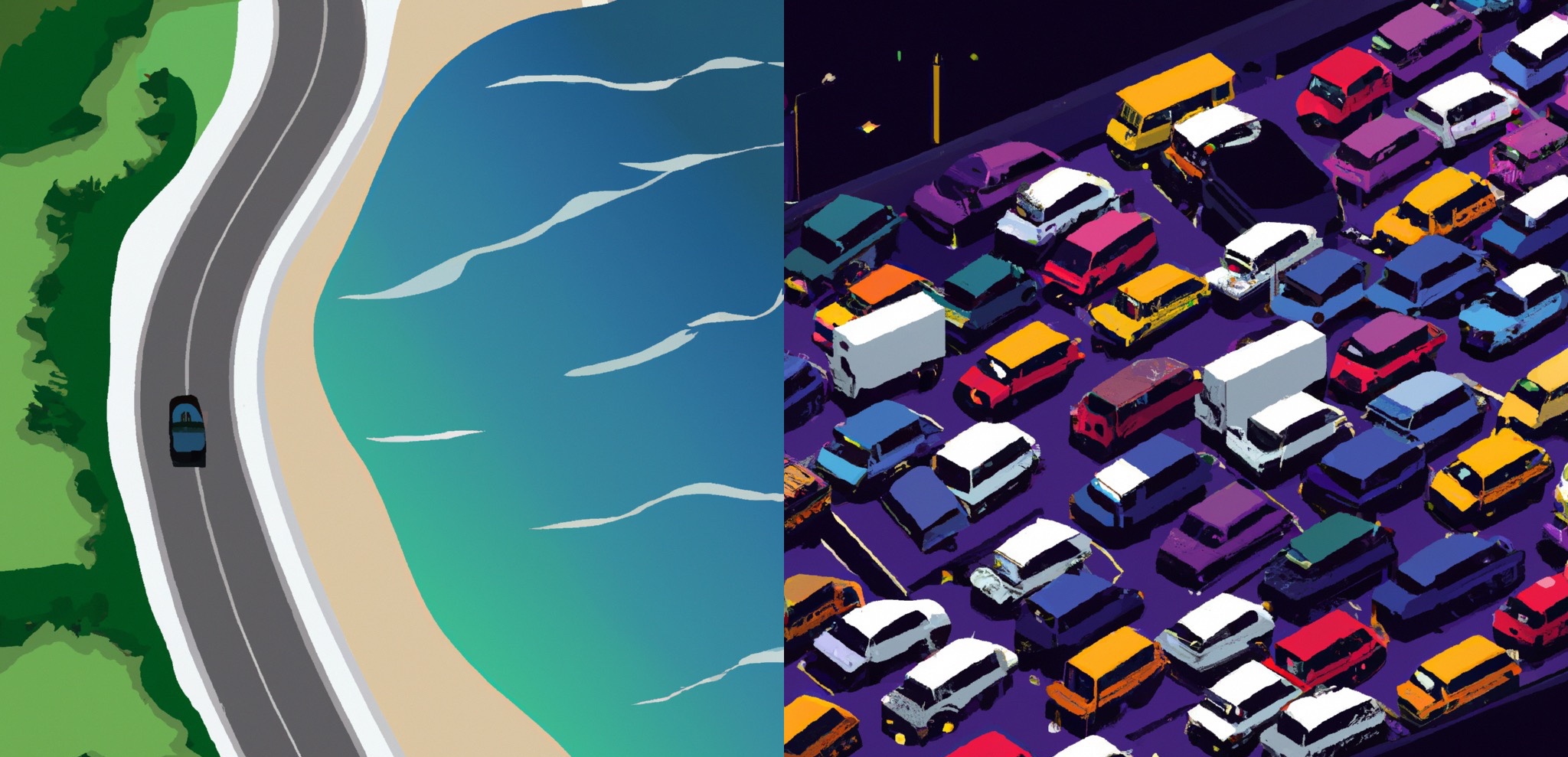
Imagine driving along the serene shoreline, with the vast expanse of the sea by your side. Or picture yourself in an open hatch car, cruising through the landscapes of Tuscany in Italy. The road ahead is clear, and the world seems to be moving in slow motion. You’re in control, choosing the speed you desire, feeling the wind against your face. It’s a dream, right? But then reality strikes. The number of cars on the road begins to multiply. The freedom diminishes, brakes are hit more often, honks fill the air, and the dreaded traffic jam looms ahead. A scenario all too familiar in mega cities like Tokyo, Mumbai, Paris, London, and New York. A nightmare, isn’t it?
The Ant Traffic System:
But what if I told you there’s a creature, without eyes, that has seemingly cracked the code to this problem? A creature that doesn’t slow down even when its path gets crowded. An intelligent being that uses a unique form of communication, far superior to our GPS systems, to navigate and collaborate. Intrigued? If you’re nodding in agreement, then we’re on the same page.

Our Research Process:
Back in 2010, a study revealed a fascinating fact about ants: their speed remains consistent, regardless of how many fellow ants are on their trail. The question that intrigued many was, “How do they manage this?” This curiosity led us, a team at Keio University’s Graduate School of Systems Design and Management, to embark on a research journey in 2014. Our mission? To decode the secret behind the ants’ efficient traffic system. By 2019, we had our first major findings ready for the world.

Key Findings:
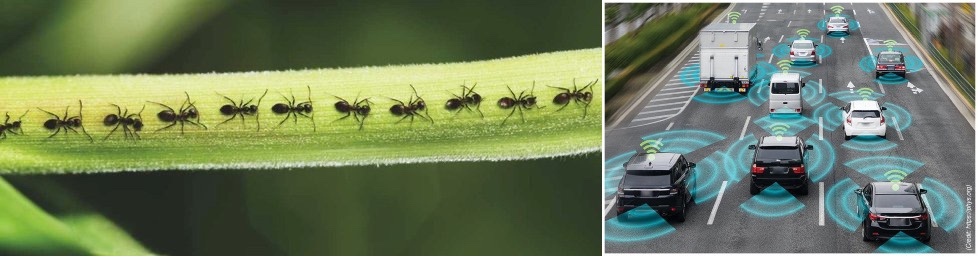
Our research unveiled that ants, much like us, do face ‘traffic jams’. Especially when their trails are bustling with activity, ants often have to halt and then proceed, much like our stop-and-go traffic. But here’s the catch: despite these pauses, their average speed remains unchanged. How do they achieve this? The answer lies in their organization and their unique chemotaxis behavior. When the trail isn’t crowded, ants move freely. However, as the numbers swell, they form groups or ‘platoons’. Within these platoons, ants collaborate to optimize their collective performance, enhancing their efficiency. Moreover, they maintain gaps between platoons. These gaps act as ‘Jam Absorption Buffers’ (JAB). In layman’s terms, a JAB allows the system to accommodate any congestion from the platoon ahead, ensuring smooth flow.
Applying Ant Wisdom to Our Roads:
Now, the million-dollar question: Can we replicate this in our vehicular traffic? The optimistic answer is a resounding “Yes!” Studies already hint at the feasibility of such a system. But how do we harness data to make this a reality? What kind of data would be pertinent? And how do we make informed decisions based on this data? While these questions might seem daunting, rest assured, we’ve delved into these aspects in our subsequent publications.
For interested scientists, you can delve deeper into our findings by reading the detailed paper here. Engineers keen on collaborating or exploring practical applications can reach out to me here. And for the curious minds, feel free to drop your questions in the comments below. I’m eager to collaborate and explore this fascinating realm further!
Disclaimer: Generative AI has been utilized for proofreading and linguistic refinement. I firmly believe that generative AI is a valuable tool that enhances efficiency.
 Prafull Kasture
One Reply to “”