Summary:
Ever wondered why ants don’t face traffic jams, even on their busiest trails? Dive into our research as we decode the ants’ remarkable traffic system and explore how their strategies might just be the solution to our urban congestion woes.
Original Research Papar: Analysis of Microscopic Behavior in Ant Traffic to Understand Jam-free Transportation
Revisiting Ant Traffic: The Individual Perspective
In our last article, we delved into the collective mechanisms ants employ to avoid traffic jams. However, ant traffic isn’t just about the collective; it’s a culmination of individual ants making decisions based on their immediate circumstances. These individual decisions collectively lead to the jam-free traffic we observe in ants. To truly understand and potentially replicate this in our traffic systems, we needed to study these individual behaviors. And that’s precisely what we did in the next phase of our research.
Delving into Ant Behavior: A Detailed Study
Building on our previous research, we utilized the ant traffic model we discussed earlier. This model allowed us to simulate and understand ant behavior in various scenarios. The insights we gained were nothing short of fascinating, and we’ve summarized them for you below.
Decoding Individual Decisions: Ants in Focus
Ants adjust their velocity based on the conditions ahead of them. When the distance between an ant and the one ahead decreases, the ant increases its speed, leading to a compact platoon formation. Furthermore, ants tend to speed up if there are more ants ahead in the same platoon. Conversely, they maintain a greater distance if the ant ahead is not part of their platoon. This behavior ensures that ants maintain their jam absorption mechanism, preventing traffic congestion.
Ants vs. Cars: Contrasting Traffic Behaviors
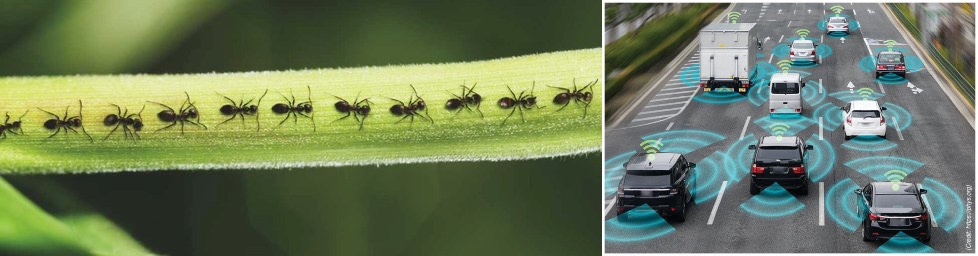
In human vehicular traffic, drivers typically reduce speed when they’re too close to the vehicle ahead, primarily to prevent collisions. Ants, however, seem to adopt the opposite strategy, possibly because they aren’t as affected by collisions as vehicles are. While directly mimicking ant behavior in vehicular traffic might not be feasible, there’s still much to learn. Human drivers typically base their decisions on the vehicle directly ahead. In contrast, ants consider multiple factors: the flow of traffic in the recent past, the number of ants ahead in their platoon, and the density of ants in the platoon. This multi-faceted decision-making allows ants to collaborate at the platoon level, optimizing traffic flow.
Towards a Jam-Free Future: Lessons from Ants
The question remains: Can we integrate these insights into our traffic systems? While the direct application of some ant behaviors might not be feasible, understanding the principles behind their traffic management can offer valuable insights. By harnessing data and technology, we might be able to develop systems that consider broader traffic patterns, much like ants do. This could be the key to creating more efficient, jam-free roads in our cities.
For interested scientists, you can delve deeper into our findings by reading the detailed paper here. Engineers keen on collaborating or exploring practical applications can reach out to me here. And for the curious minds, feel free to drop your questions in the comments below. I’m eager to collaborate and explore this fascinating realm further!
Disclaimer: Generative AI has been utilized for proofreading and linguistic refinement. I firmly believe that generative AI is a valuable tool that enhances efficiency.
 Prafull Kasture