

Summary:
WE USE SWOT WRONG.
Ever found yourself pondering over the untapped potential of SWOT analysis? Journey with us as we delve beyond the conventional uses of this powerful tool, exploring the intersections where revelations and actionable insights lie in wait. From balancing strengths and weaknesses to evolving amidst external shifts, we unravel strategies and probing questions that promise to elevate your approach to SWOT analysis. It’s not just about jotting down points; it’s about diving deeper, learning, and strategizing to navigate the realms of possibilities and uncertainties, ensuring a journey truly beyond the matrix.
A Tale of Two Meetings:
Once upon a time, a project manager summoned the team for a crucial meeting. The agenda was clear: SWOT was a required project outcome, and it was time to brainstorm. The team delved deep, filling the SWOT quarters with insights. Satisfied with the substantial points gathered, the manager declared the task complete, ready for submission. And there I was, my head dropping in disappointment.
In another scenario, a new boss and his managers were unveiling their fresh strategy and targets. They had spent a day-long workshop crafting a new strategy, with SWOT at its core. After presenting the points on the SWOT matrix, the leadership swiftly moved to focus areas, picking few to target that year (Logic: “we picked the low hanging ones”). And again, my head dropped. Not this again.
The Untapped Potential of SWOT:
SWOT is an exceptional tool for strategy formulation. In essence, strategy is a collection of decisions that position an enterprise, team, or individual in a favorable position to achieve success. SWOT is one of the tools that assist us in making these decisions. Just like any strategizing exercise, before the analysis, it’s best to define the vision and mission for the endeavor. Only then can analysis like SWOT create value. While the larger strategy formulation is a complex and extensive process, the simplicity of SWOT makes it one of the most used tools, enabling anyone to learn, analyze, and make decisions about any context. However, its full potential often remains untapped.
The Essence of SWOT:
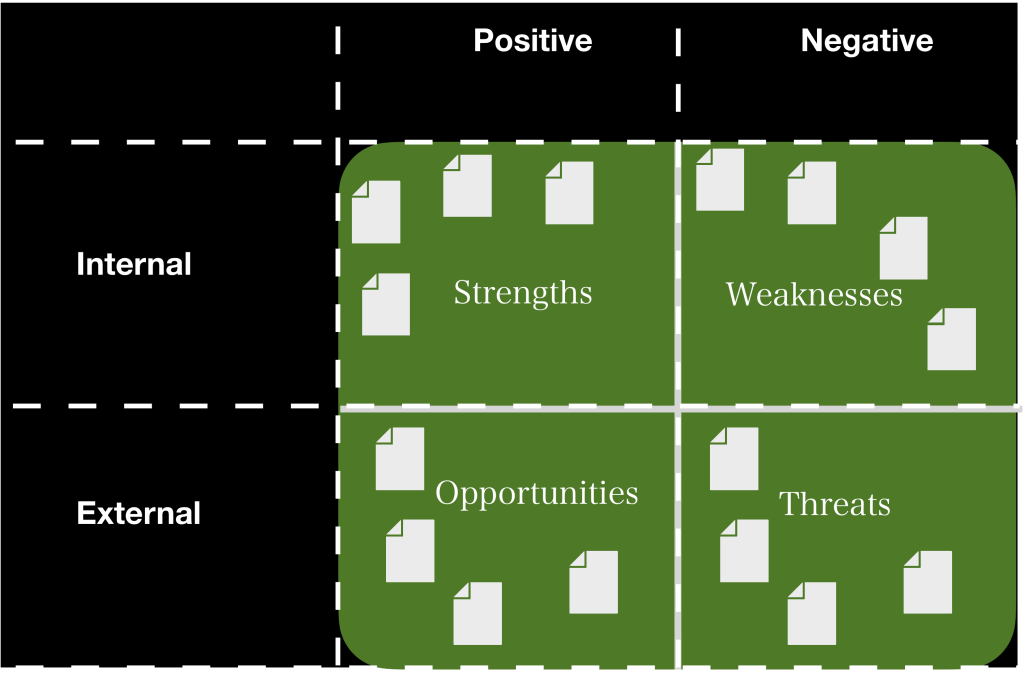
SWOT is a straightforward 2X2 matrix that categorizes four aspects: Strength, Weakness, Opportunities, and Threats. The two columns represent positive and negative factors, while the two rows encompass internal and external aspects. As we mentioned earlier, it’s crucial to define a vision and mission before conducting a SWOT analysis. This is because the information required to fill in the SWOT chart must be relevant to the defined mission and vision. The primary objective of SWOT is to provide insights into future decisions that will position us in a favorable position to achieve our mission and vision. These decisions are based on our current strengths and weaknesses, while also considering the external opportunities and risks that exist.
Navigating the Crossroads of Reflection: Unearthing Profound Insights at the Intersections:
The intersections of the SWOT matrix are where we find actionable insights and revelations. It’s here that we ask probing questions and uncover strategies to move forward. This method of utilizing SWOT has been my go-to for a more holistic and insightful analysis. Let’s walk through these intersections with a practical lens:
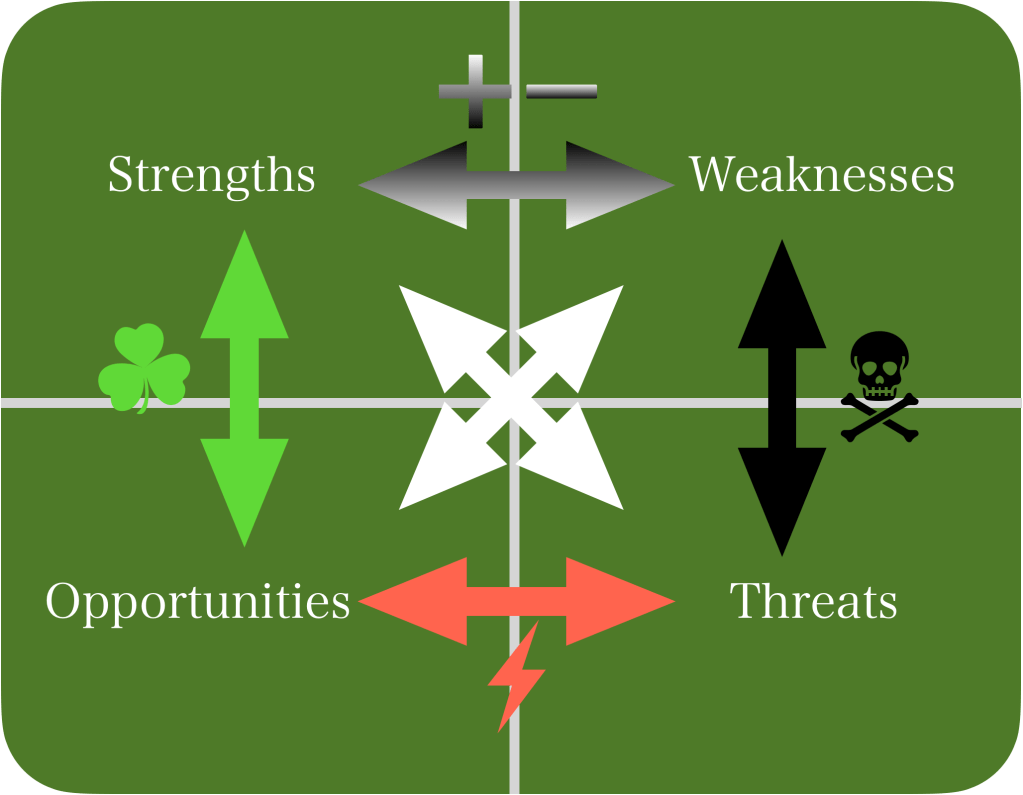
- Gaps: Balancing Strengths and Weaknesses
- Actions: Examine your strengths and weaknesses. Do some of them come in pairs? If so, strategize on balancing them effectively.
- Questions to Ask: How can we maximize the benefits of our strengths while managing the losses due to weaknesses? What’s our strategy to maintain this balance?
- Luck: When Opportunity Meets Preparation (Strengths)
- Actions: Identify the strengths that are related to some of the opportunities. Strategically focus your efforts on maximising these alignments.
- Questions to Ask: How can we enhance these strengths through strategic decisions to seize the related opportunities? Are we allocating enough resources to these aligned areas?
- Curse: Mitigating Weaknesses and Threats
- Actions: Spot where weaknesses intersect with external threats. Develop strategies to fortify these weaknesses.
- Questions to Ask: How can we focus on fortifying these weaknesses to withstand the external threats? What proactive measures can we take to minimize the impact of these threats?
- Risk: Navigating External Uncertainties
- Actions: Explore the relationship between external opportunities and threats. Assess the uncertainties and develop contingency plans.
- Questions to Ask: How can we handle the uncertainties related to opportunities and threats and vice versa? Are we prepared to pivot our strategies based on evolving external factors?
- Irrelevance: Evolving Amidst External Shifts
- Actions: Regularly assess how emerging external threats could render your strengths irrelevant. Develop strategies for adaptation and continual evolution to stay ahead of the curve.
- Questions to Ask: Are we proactively evolving our strengths to counteract the emerging threats? Are we maintaining our competitive edge and staying ahead of industry shifts?
- Despair: Bridging Weaknesses and Opportunities
- Actions: Identify where your weaknesses intersect with opportunities. Develop rapid enhancement strategies or seek collaborations to leverage these opportunities effectively.
- Questions to Ask: How can we swiftly overcome our weaknesses to leverage these opportunities? Can forming strategic partnerships help us bridge the gap more effectively and seize these opportunities?
Integrating Insights for Holistic Strategy Formulation:
Once we unearth new insights, ranging from Gaps to Despair, it’s pivotal to view these insights in a holistic sense. For instance, if “Luck” is identified, it’s essential to start probing further. What risks might be intertwined with this newfound idea or insight? Are there any weaknesses that could potentially be linked to this insights? It’s by contemplating these multifaceted aspects that we can formulate comprehensive and robust strategy statements, ensuring that every angle is considered and every potential pitfall is anticipated.
Refining Strategy Through Rigorous Validation:
Halting the process post the identification of insights would be our gravest error. At the culmination of a SWOT analysis, what we possess is essentially a brainchild of our perceptions and thoughts. However, our perceptions might not be the reality. At this juncture, what we hold is a strategy hypothesis, a preliminary model that requires rigorous testing and prototyping for further refinement.
It’s crucial to question the assumptions underpinning our hypothesis. What are the foundational truths that need to stand firm for our strategy to succeed? By addressing such pivotal questions, we can meticulously plan prototypes and conduct tests to refine our strategy, ensuring its resilience and effectiveness.
This rigorous approach transforms our initial insights into a robust and exciting strategy, fortified by empirical validation and holistic consideration, promising not just viability but also a substantial impact in the real world.
By focusing on these practical steps and probing questions, we can transform the SWOT analysis from a static matrix to a dynamic tool for strategic thinking and decision-making.
Conclusion:
SWOT is not just about listing points in four quarters. It’s about delving deep into each point, analyzing the intersections, and asking the right questions. It’s about transforming these insights into actionable strategies, making informed decisions, and ultimately, creating a meaningful impact. So, the next time you encounter a SWOT analysis, don’t just stop at the points, go beyond, and unravel the untapped potential it holds. If you have other ways of utilizing SWOT, do share; the journey of learning is ever-evolving.
Disclaimer: Generative AI has been utilized for proofreading and linguistic refinement. I firmly believe that generative AI is a valuable tool that enhances efficiency.
 Prafull Kasture